


Hi everyone!
I’m really excited to publish this. I’ve taken an extended break because I’ve been busy with a lot of things. But I’m finally back in the throes of Substack and I actually feel like I want to write—and I’m excited to do so, rather than just forcing myself to every week. There’s so many new people here which initially, scared me to think about because the realisation that my writing was being consumed by a larger audience than I expected put me on the spot and made me reluctant to publish anything. But I’m so grateful for all the support that I’ve been shown over the last few years. Downtalk’s managed to get over 500 subscribers and it’s unbelievable that the publication’s come this far.
I’ve been reading and watching a lot of books and media this year, and I have lots to talk about as well as a ton of recommendations of my personal favourites, so I hope you all enjoy this; it’s probably my longest post to date. Just to also mention, there will be some spoilers about plot related things. Please also check trigger warning before reading these books to be aware of anything that might upset you. If any of you have read any of these books, please give me your thoughts!
I read twenty-five books this year. For comparison, I only read six last year, and eleven in 2023. I managed to read six books about a month into 2025 and eleven in about three months, so I already exceeded both in a quarter of the year! For a complete list of all the books, I’ve added them all here. The ones with a link are novels that I’ve written individual posts on already, and those highlighted in bold are my personal recommendations.
The Remains Of The Day by Kazuo Ishiguro
Small Things Like These by Claire Keegan
On The Road by Jack Kerouac
Blood Meridian by Cormac McCarthy
Time Is A Mother by Ocean Vuong
My Year Of Rest And Relaxation by Ottessa Moshfegh
Two Stories by Sally Rooney
Dearly by Margaret Atwood
The New Rulebook by Chris Cheers
The Death of Ivan Illyich by Leo Tolstoy
Brave New World by Aldous Huxley
The Year of Magical Thinking by Joan Didion
Moshi Moshi by Banana Yoshimoto
The Pachinko Parlour by Elisa Shua Dusapin
Dune: Messiah by Frank Herbert
Lucky Ticket by Joey Bui
Greek Lessons by Han Kang
One Piece: Heroines Volume 1 by Jun Esaka
One Piece: Shokugeki no Sanji by Yuto Tsukuda
My Twentieth Century Evening and Other Small Breakthroughs: The Nobel Lecture by Kazuo Ishiguro
Letters to a Poet by Rainer Maria Rilke
One Piece Heroines Volume 2 by Jun Esaka
The Remains Of The Day by Kazuo Ishiguro
“But then, I suppose, when with the benefit of hindsight one begins to search one’s past for such ‘turning points,’ one is apt to start seeing them everywhere.”
Mr. Stevens is a dedicated butler who reminisces about his life, thinking back on the downfall of his previous employer Darlington, and his relationship with Miss Kenton, the former housekeeper. The novel focuses on his feelings of nostalgia and grief as he reaches eventual acceptance and decision to move forward with his life.
Somehow, Ishiguro has managed to worm his way into my heart and has become one of my favourite authors. I remember reading Never Let Me Go in my last year of high school, and back then, I wasn’t really a fan. However, after some thinking, and especially after reading Klara And The Sun (which is one of my favourite novels), I’ve come to regard Ishiguro very highly for his prose and theme focused writing.
The journey of realisation that Stevens goes through in what’s only 200 or so pages is genuinely moving. Steven’s faces his buried feelings for what happened to Darlington, wasting years of service, and letting the opportunity of being with Miss Kenton go, while simultaneously pledging to live the rest of his life, is so bittersweet. And it truly doesn’t hit you until you reach the last quarter. This is actually something that Ishiguro discusses in his essay and speech My Twentieth Century Evening and Other Small Breakthroughs, the idea of a story coming full circle at the end. I enjoyed reading this one a lot and I’ll definitely be reading more Ishiguro in the future.
Normal People by Sally Rooney
“Most people go through their whole lives, without ever really feeling that close to anyone.”
Connell and Marianne used to secretly date in high school. After going seperate ways, they continue to meet throughout their lives, rekindling at different stages, and slowly unpack their relationship and past lives.
It only took me about two or three days to read this. I was so engrossed in the book that I just kept reading, which is something that hasn’t happened to me in a while. Connell and Marianne are two very interesting and frustratingly flawed characters, who feel very much so annoyingly real and watching their relationship and cyclical dynamic was both irritating and great. Miscommunication—or rather, no communication, is at its peak here. There’s also a show starring Paul Mescal and Daisy Edgar-Jones which I’m keen on watching because I’ve heard it’s a really good adaption.
Small Things Like These by Claire Keegan
“What would life be like, he wondered, if they were given time to think and reflect over things.”
Set during the Christmas season, this historical fiction novel revolves around a man, Bill, who slowly beginnng to realise the cruel and exploitative treatment of young, unmarried mothers at the hands of the local convent which runs a Magdalene Laundry.
Blood Meridian by Cormac McCarthy
“War was always here. Before man was, war waited for him. The ultimate trade awaiting its ultimate practitioner.”
Kid is a young boy who joins the Glanton gang, a group of scalp hunters who travel along the United States-Mexico border. A part of that group is the ominous Judge Holden, an uncanny, unearthly figure more akin to a demon that a human who enjoys in destroying everything he sees.
I’m not sure if I like Blood Meridian. It took me a long time to finish reading. The lack of grammar—which I recognise is a stylistic choice, bothered me a lot, and I felt that the majority of the story didn’t have anything going on. The majority of the book is descriptions of the landscape, the environment and the characters travelling place to place. But the last quarter of the novel feels like an entirely different book than the rest. The Judge as a character is wholly unique, and the eeriness of his character is definitely… something unsettling. Judge as this sort of maliciously haunting force is truly horrifying, and the ending bothers me very deeply.
While Blood Meridian left me with more questions than answers, I think that it’s an interesting depiction of the Wild West and the brutality and nihilistic nature of the world at that point. Plus, there’s some sick art of the book and its characters: I remember seeing this reel on Instagram that convinced me to read it.
Time Is A Mother by Ocean Vuong
“How you can love the world until there’s nothing left to love but yourself.”
Vuong’s second published poetry collection, focusing on the aftermath of his mother’s death as well as grief, family, loss and war.
My Year Of Rest And Relaxation by Ottessa Moshfegh
“Oh, sleep. Nothing else could ever bring me such pleasure, such freedom, the power to feel and move and think and imagine, safe from the miseries of my waking consciousness.”
In 2000, after her parents pass, a young woman who is our unnamed narrator, chooses to use drugs and alcohol to rot in her apartment for an entire year.
It’s short and I absolutely ran through the book; despite nothing going on in the novel except for the narrator wasting away the days in a drug-induced sleep, a lot is happening around her and in her thoughts. I especially felt for her friend Reva who was desperate to connect to her, going through problems of her own with little support. I also definitely wasn’t expecting the ending which threw me for a loop.
Two Stories by Sally Rooney
“A pain in your throat may get worse when you swallow, may be almost unbearably painful when you swallow, but that doesn’t mean that the pain is gone when you’re not swallowing.”
A compilation of two stories. The first is Mr Salary, where a young woman moves into an older man’s apartment after her mother’s passing and difficulty living with her father, encountering issues between the two of them that cause their relationship to fizzle out. The second, In Colour and Light, is about a man and woman with a fractured relationship who watch the fireworks in a tense, awkward interaction.
Both stories were nice, touching on the topic of unstable relationships, feelings of uncertainty and miscommunication. I found it similar to Normal People in that sense. I also love Rooney’s writing style, so this short collection was easy and enjoyable to read.
So Late In The Day By Claire Keegan
“Then a line from something he’d read somewhere came to him, to do with endings: about how, if things have not ended badly, that they have not ended.”
A man, Cathal, analyses and retraces his steps after breaking up with a woman, Sabine, who he could have spent the rest of his life with if he had acted differently.
Another Keegan book. I was really impressed and enjoyed Small Things Like These, and I’ve seen a lot of good reviews for this so I decided to read it. For being so short, it’s very complex and introspective, exploring how misogyny manifests within their relationship and its ultimate dissolution because of it. Cathal reflects on how his father treated his mother in his childhood and how his environment shaped his external behaviours, which was incredibly realistic and saddening.
Dearly by Margaret Atwood
“The world that we think we see is only our best guess.”
A collection of poems focusing about various themes such as love, loss, time, and more, some with a personal lens as well.
I’ve been meaning to read more poetry and prose and managed to read a fair bit last year. I enjoyed this a lot; Atwood’s poems were easy to engage with whilst also having a lot of substance, and I especially liked the first half. I’ve also had The Handmaids Tale on my TBR for years now, which I’ll be reading very soon.
Dear Dolly by Dolly Alderton
“It’s not the absence of fun, it’s the absence of fear.’ Keep this in mind when you are looking for someone to share your life with – someone who’ll bring fun without fear. Someone whose company you love. Someone who makes you feel alive and safe and understood. Those are the specifics you should be looking for. The rest doesn’t matter so much.”
A curated collection of questions from Alderton’s ‘Dear Dolly’ Sunday Times Agony Aunts section. They focus on family, friendship, love and relationships and she answers and gives advice for people submitting them.
At the time of reading (or rather, listening to this, as it was an audiobook), I was kind of at a loss in life. Dear Dolly left me feeling seen in some way. A lot of people that wrote to the section had such realistic problems, and for some of them, I could relate a lot. It was also a reminder that we’re all just so human, that we all experience some things the same in some manners. The book was a refreshing reminder of that.
The New Rulebook by Chris Cheers
“Led not by expectation, but by what you need.”
Cheers, a psychologist, unpacks evidence-based solutions and advice for five key areas: self-care, feelings, work, body and love, that will hopefully positively address your wellbeing.
I’m not one for self-help books or anything related, but Cheers’ book helped me take a step back and look at how I take care of myself. This was especially important to listen to because I’d been in my first year of a new program amongst other experiences so I was stressed out, and this was just what I needed to help kickstart me into focusing on that.
The Death of Ivan Illyich by Leo Tolstoy
“The example of a syllogism that he had studied in Kiesewetter's logic: Caius is a man, men are mortal, therefore Caius is mortal, had throughout his whole life seemed to him right only in relation to Caius, but not to him at all.”
Ivan Illyich, a dying bed-bound man, reflects on his life and the harrowingly painful process and experience of a slow death.
While I’m fairly squeamish on topics related to death (this was a littleeee bit out of my comfort zone, considering the extremely in-depth descriptions of what death feels like) it’s very well written. Tolstoy really delves into Ivan’s physical decline and psychological turmoil, which culminates in an eventual acceptance of death as his time draws near at the end of the novel.
Brave New World by Aldous Huxley
“I'm claiming the right to be unhappy. Not to mention the right to grow old and ugly and impotent; the right to have syphilis and cancer; the right to have too little to eat, the right to be lousy; the right to live in constant apprehension of what may happen tomorrow; the right to catch typhoid; the right to be tortured by unspeakable pains of every kind."
Set in a futuristic and dystopian World State where people are environmentally sorted into an intelligence-based conditioned social hierarchy that rejects the idea of the family and promotes promiscuity. We follow two protagonists—Bernard and Lenina who bring back a John, man from a ‘Savage Reservation,’ and introduce him to their world, with harrowing consequences.
I’ll be completely honest in saying that I can’t remember this all too much because I read it very early into 2025. It’s a short read however, taking a look at interesting concepts such as how societal expectations shape our lives and what values it upholds and how this systematically ‘others’ those who don’t fit in the mold.
The Year of Magical Thinking by Joan Didion
“I know why we try to keep the dead alive: we try to keep them alive in order to keep them with us. I also know that if we are to live ourselves there comes a point at which we must relinquish the dead, let them go, keep them dead. ”
Didion recounts the experiences she went through after the illnesses faced by her daughter, Quintana, and later, the death of her husband, John Gregory Dunne.
This was so difficult to read solely because of how intense it was. Didion’s daughter went into a coma and was placed on life support after going into septic shock from the flu, which developed into pneumonia. After a trip to the hospital to see her, her husband John had died suddenly during dinner, having a coronary attack. Didion’s thought process after the events and being in such a position, talking about grief, loneliness and how to survive it all was so raw and harrowing. While obviously upsetting, It’s a very, very good novel.
Moshi Moshi by Banana Yoshimoto
“It takes time to get to know people, let alone to tell whether you like each other, so it really makes me wonder, you know, what you’re supposed to do if they just keep coming through like a revolving door, in one day and out another, and you don’t even have time to figure out who they are?”
Yoshie’s father dies after committing a suicide pact with the woman he has been cheating on his wife with. As a result, the family house becomes haunted with the literal and figurative ghost of him. Yoshie’s lonely mother moves in with her and toether the two try to move forward.
Moshi Moshi starts off with an interesting premise and concept but ultimately for me it falls flat in delivering. Yoshie and her grief is poignantly explored, and some of the lines regarding her inner thinking and introspection were genuinely captivating. The first half had a lot of this and the way Yoshitomo writes Yoshie and her navigating her early twenties also was lovely.
However, I thought her father’s ghost would play a larger part in the story than he did, and in the same vein I thought there would be a little more exploration of her and her mother’s dynamic, which was interesting. The ending, as well as some plot choices—especially the last 100 pages or so, really put me off the entire book. The cover is very beautiful though, and it is a short read. I’m planning on checking out more of Yoshitomo’s works.
The Pachinko Parlour by Elisa Shua Dusapin
“I like it when it’s foggy. When you can’t see into the distance. When there’s no horizon. It gives me a feeling of having time. That it’s all right not to see, not to be aware of what’s in my path.”
Claire, a Korean-Swiss graduate, finds herself tutoring a young girl called Mieko while planning a trip to Korea with her grandparents who haven’t returned since the civil war 50 years ago.
The Pachinko Parlour is short, only around 200 pages. However, it managed to tell such a comprehensive and interesting story in such a short time that I can’t help rating it highly. Focusing on Claire’s relationship with her identity, the book is so well written, with my personal highlights being seeing her grow closer to Mieko and becoming an older sister as well as the ending where she takes the decision to embark to Korea. Definitely one of my favourite reads this year.
Dune: Messiah by Frank Herbert
“The flesh surrenders itself. Eternity takes back its own. Our bodies stirred these waters briefly, danced with a certain intoxication before the love of life and self, dealt with a few strange ideas, then submitted to the instruments of Time. What can we say of this? I occurred. I am not...yet, I occurred.”
A sequel to Dune that takes place 12 years after, exploring a new threat that a dejected Paul must face.
Having read this, I do prefer the first Dune novel to Messiah. However, exploring Arrakis and Paul’s legacy post-Dune is an interesting concept, especially seeing how Paul’s become so disillusioned with himself after everything he’s done. The new characters, such as Scytale, are great as well. He’s going to be played by Robert Pattinson in the third Dune film, which I’m very excited to see.
Overall though, this sequel just didn’t feel like it was connected to the first book and kind of felt like it was it’s own, independent thing. Despite the fact that this is a quarter of the length of the first, nothing really happens until the middle/end. I also didn’t like the writing or characterisation of Alia, especially her relationship with one of the other characters later. I’m still planning on reading Children of Dune to see how it follows up.
Lucky Ticket by Joey Bui
“One day you have a lucky ticket and get a dinner so good and you eat so much that you think you'll never need to eat again.”
A collection of stories focusing on Asian voices, exploring identity through the scope of war, relationships and generational sturggles. The characters range from a disabled old man who sells lottery tickets on the streets of Saigon to a strained relationship between two friends in Melbourne.
Despite each chapter being its own individual story, the characters felt very fleshed out and real—all varied, unique and facing their own problems, which I appreciated a lot. No chapter is the same, and Bui tackles a bunch of different topics within each one. My favourites were “Mekong Love,” “Before The Lights Go Out” and “Whitewashed” if I had to pick, but the whole book was well written and compelling. The protagonists all felt very strongly characterised as well.
Greek Lessons by Han Kang
“Language as cold and hard as a pillar of ice. A language that does not wait to be combined with any other prior to use, a supremely self-sufficient language. A language that can part the lips only after irrevocably determining causality and manner.”
A selectively mute woman enrols in an Ancient Greek language class and connects with her teacher, a man who’s slowly becoming blind.
I don’t want to discuss in length how much I love this novel because I’m saving that for an upcoming post, but between The Pachinko Parlour and Greek Lessons, I genuinely can’t decide which is my absolute favourite read. This is so beautifully written, incredibly tragic at times, and it really had me thinking about my own connection to the languages I know. Kang writes and breathes life into these characters so effortlessly, and the way they interact with each other as well; I can’t wait to read more of her work.
One Piece: Heroines Volume 1 by Jun Esaka
““As long as your thankful to be alive and stay true to yourself, all sorts of wonderful things will come to you,” Nami assured her.
“How can you be so sure?”
“Someone important taught it to me.””
I’ve always been a big fan of anime in general. When I was a kid, I used to watch Sailor Moon, Cardcaptor Sakura, YuGiOh!, and Astro Boy all on VHS tapes. This is something that’s continued to now, and along with this, reading manga. One Piece was always something that I felt was far too long to be worth the effort at over 1,000 episodes and it was never appealing to me because I truly thought it was just action slop—which is funny, because having now caught up to it, I think it’s my favourite anime/manga of all time and I’m glad to have been proven wrong. I watched the entire thing in only three months earlier this year and I’ve been following the Egghead arc ever since, which is due to finish at the end of this month.
It’s truly a beautiful story of wanting to achieve one’s dream and how our ambitions drive us and shape our identities, family/friendship and mainly love—love for yourself, others, your passions, and more. It’s unironically been a great motivator in boosting my mood, and my desire to achieve my own goals because Luffy, the main character, is simply that infectious. With BookTok discovering One Piece and it getting the literary attention it rightfully deserves, I hope One Piece as well as other animanga will come up more in this space.
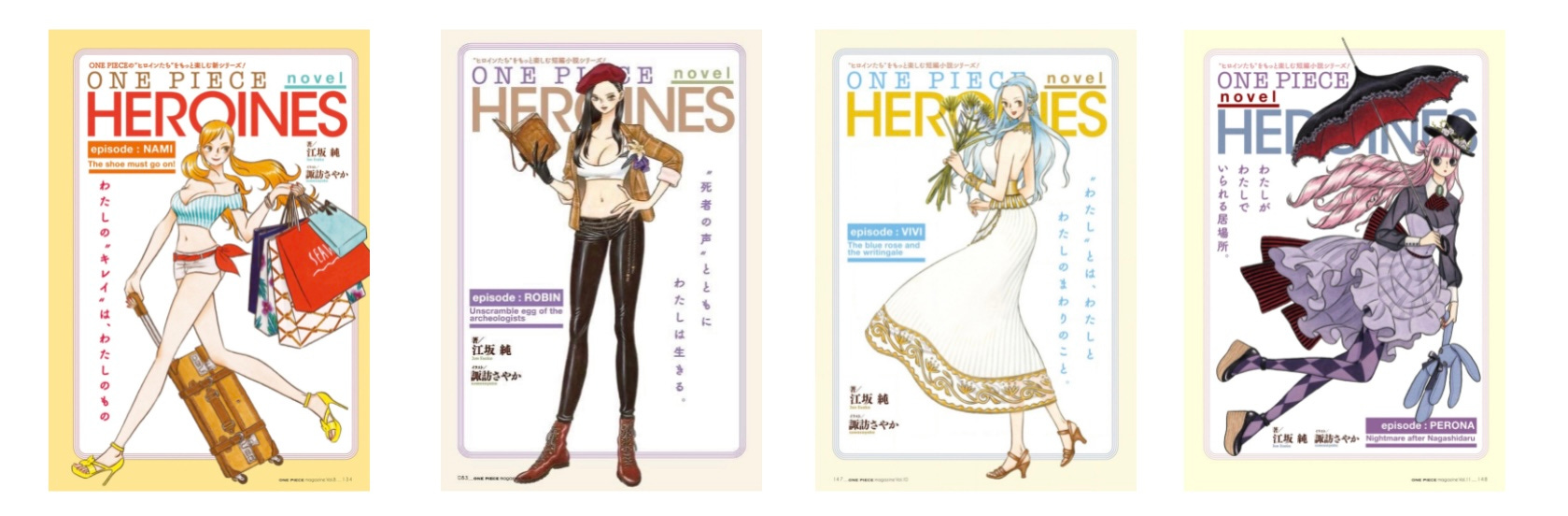
Heroines is a spin-off novel that contains the stories of four female characters: Nami, Robin, Vivi and Perona, in different situations, with a bonus chapter. I thought it was pretty cute; I would consume literally anything related to One Piece. It comes with accompanying art in the book as well as illustrations scattered throughout the chapters. It’s also getting an animated adaption that will come out either next year or in 2027!
One Piece: Shokugeki no Sanji by Yuto Tsukuda
“The All Blue! Wow! It has all the fish from the four seas?! I wanna go there! Someday…Once I’m finally out here…”
A look at Sanji, the chef of the Strawhats, and some moments from his life focused on cooking.
This is also another spin-off, this time revolving around Sanji, one of the main characters. It was written and drawn by the creators of the popular animanga Food Wars, Yuto Tsukuda and Shun Saeki. Split into seven chapters including a bonus one, each one is a really good insight into Sanji’s love for cooking and how he takes on various challenges. From precision cutting a rare fish using Zoro’s sword to accomplishing the most difficult dish at the Baratie for a customer using limited food sources, it showcases his strong personality perfectly. The identity of a chef is something that’s defined him from childhood and it feeds into his desire to find the All-Blue, a rumoured fantastical sea where fish from all parts of the sea swim.
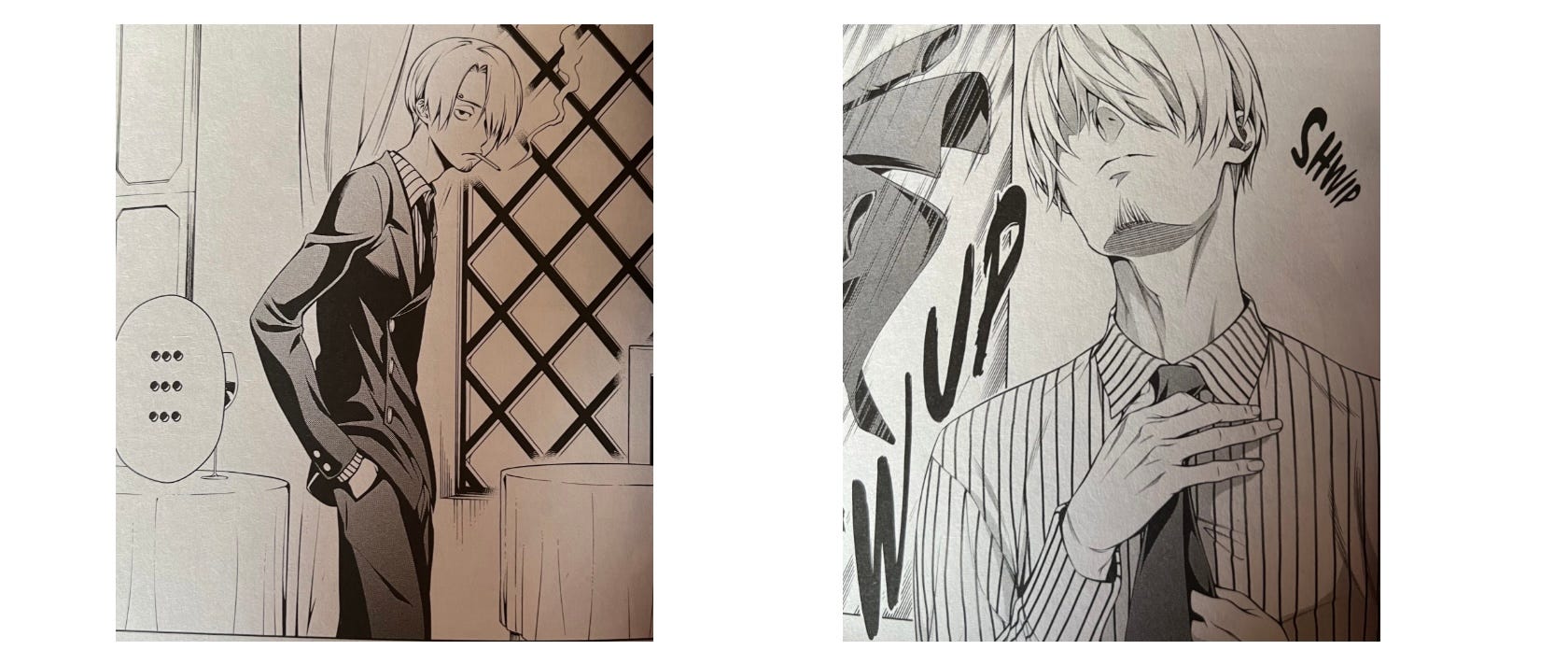
Sanji is one of my favourite characters so I really enjoyed reading this. A lot of effort went into creating the spin-off with tons of details too. My favourite tidbit is the Tsukuda and Saeki initially choosing to have Sanji loosen his tie when it comes to cooking seriously, something that Eiichiro Oda, the original creator, said would actually be the opposite: Sanji would tighten his tie instead, as a quirk. Both of them worked pretty hard to ensure Sanji would act as close to canonically possible and it builds upon his character in the best way.
My Twentieth Century Evening and Other Small Breakthroughs: The Nobel Lecture by Kazuo Ishiguro
“Stories can entertain, sometimes teach or argue a point. But for me the essential thing is that they communicate feelings. That they appeal to what we share as human beings across our borders and divides. There are large, glamorous industries around stories; the book industry, the movie industry, the television industry, the theatre industry. But in the end, stories are about one person saying to another: This is the way it feels to me. Can you understand what I’m saying? Does it also feel this way to you?”
A written transcript of Ishiguro’s 2017 Nobel Laureate lecture, Ishiguro discusses his writing process, the background to his novels, and what writing means and represents to him.
It’s a short read, only around 5o pages, but it’s so good. I’ve always had a difficult time capturing how I feel about writing—something that I’ve been writing about a lot funnily enough, but here Ishiguro managed to sum it up perfectly. I’ve always wanted to create in hopes of 1) making others feel/see things they way I do, or to acknowledge it, and 2) to have people connect to my work the same way I connect to others’ works. It’s all about emotion, and getting that across to the reader. It’s what makes me want to be a writer, and Ishiguro has, since I first got introduced to his novels in 2021, been a very strong inspiration to me. I would seriously suggest to anyone, to read this. It won’t take you very long but it’s profound. If you want to watch it instead, here’s the link.
Letters to a Poet by Rainer Maria Rilke
“Keep growing quietly and seriously throughout your whole development; you cannot disturb it more rudely than by looking outward and expecting from outside replies to questions that only your inmost feeling in your most hushed hour can perhaps answer.”
A collection of poems Rilke sent to a punk friend, containing advice ranging from writing, love/relationships, suffering and more.
Letters to a Poet was on my TBR for a very long time, and after finally reading it I can see why everyone rates it so highly. Rilke provides a lot of thoughtful musings that I could relate to, and in particular, the ones focusing on writing drew my attention the most. I’ve been struggling with my own writing and motivations recently, having taken a very long break off from Substack. This compilation of letters really spoke to me and even kickstarted me into writing again—not just on here, but in general.
I like the fact that the writing process is universal. Sometimes I feel isolated; dips in writing occur for me a lot and it’s dificult for me to maintain that level of consistency in writing or any of my hobbies really, without the threat of burnout. Rilke effortlessly manages to capture my inner thoughts on paper as if he could read my mind.
One Piece Heroines Volume 2 by Jun Esaka
“Reiju wished she could share a meal with Sora and Sanji, just once.”
Can you tell I’m on a One Piece craze lately?
A follow up to the first Heroines book, volume two looks at stories of Hancock, Tashigi, Reiju and Uta, with another bonus chapter! This edition focuses on more of the side characters this time, putting them in the spotlight and expanding on them.
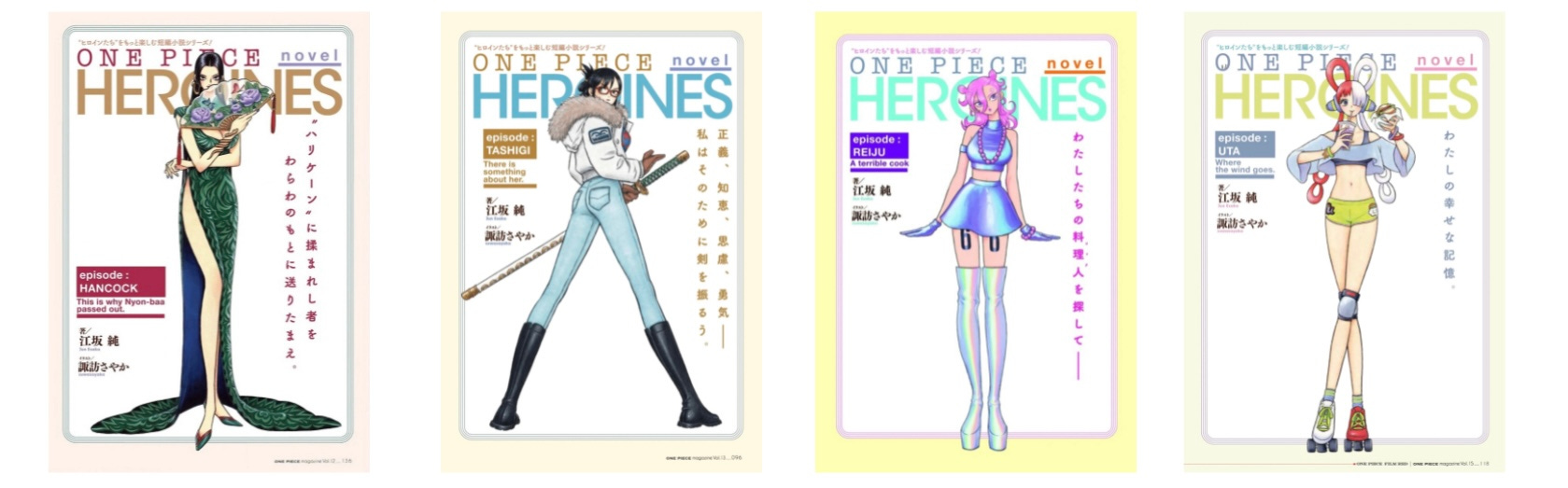
My personal favourites of the novel were Tashigi’s and Reiju’s, which look at Tashigi’s role and identity as a woman in the Marines and Reiju’s reflections on her family and what could’ve been as a princess of Germa. The illustrations are beautiful as always; I really like reading spinoff stuff like this and the others in this list because there’s so much that can be done with a fictional world as expansive, wacky and grand as One Piece, so exploring that is always interesting.
And that’s all! Having exceeded my goals, I’m looking forward to reading more in 2026. Reading has been a big comfort and being able to engage with it on such a fun level has been really great.
Goodreads 2026 goal: 0/26.
The queen is back!! I love this article and I'm happy you've found your writing comfort zone (when it comes to releasing work). Can you believe I was going to read Moshi Moshi in December but didn't have enough time?
Thanks for writing this. I have read only two books from this list: The Remains of the Day and Brave New World. But I am surprised by the overlap I see in terms of genres and authors. I read a Han Kang novel in 2025 too.
Remains was my second Ishiguro. Klara and the Sun did not fully work for me. But Remains is one of my favorites. I definitely want to read more from him. I wrote about the book here https://www.thefreudiancouch.com/2025/04/remains-of-day-kazuo-ishiguro.html.
And I had written about my books from 2025 here https://www.thefreudiancouch.com/2025/12/2025-in-books.html. You might notice the overlap too.